Platforms, sensors and models
Evaluate quadruped, humanoid or drone hardware against the task. Define sensors, model behaviour and on-board computing requirements within the manufacturer’s limits.

03 / AXENTYR Robotics
Connect sensors, AI models and operators to a defined mission on a quadruped, humanoid or drone, with links to the client’s existing systems.
Who it is for
Industrial, logistics, operations and site security managers considering missions such as inspection, internal transport, observation or assistance in a suitable physical environment.
Development status
In development. Mission software, hardware access and support arrangements are being defined by project; no equipment catalogue or deployment is announced.
The proposition
Define what the robot observes, how a model interprets it, what reaches the operator and how approved results enter the client’s tools. Mission intelligence may run on board or use an agreed connection, according to latency and connectivity constraints. Manufacturer controls and physical safety remain independent of generative AI.
Start from an inspection, assistance or observation task. Assess a suitable quadruped, humanoid or drone, then define the sensors, models, on-board computing and operator controls needed for that mission. Hardware sourcing is evaluated for each project rather than treated as an available catalogue.
Explore the Platform architecture A shared target architecture, with no required bundle of offerings.
Scope
Evaluate quadruped, humanoid or drone hardware against the task. Define sensors, model behaviour and on-board computing requirements within the manufacturer’s limits.
Specify mission stages, observations, uncertainty and operator review, including what happens when a model cannot interpret a situation or connectivity is interrupted.
Connect approved observations and mission reports to client tools. Define training, software updates, hardware maintenance, support and intervention responsibilities.
How the work is structured
An engagement starts from your objective and defines the inputs, work and validation needed to address it.
State the task, site, permitted operating area and evaluation criteria. Identify the people involved and the manufacturer or regulatory constraints relevant to the platform.
Evaluate candidate quadruped, humanoid or drone equipment and project-specific sourcing. Select sensor inputs, AI models and on-board or connected computing for the mission.
Define mission stages, operator controls, client interfaces and behaviour when data is uncertain or connectivity is lost. Keep physical safety controls separate from generative AI.
Test the scoped mission under agreed conditions, review observations and reports, and define training, maintenance and support before any operational acceptance.
Questions in context
Illustrative situations. These examples describe a question, the inputs and a result to review; they are not accounts of delivered work.
Quadruped
Humanoid
Drone
Deliverables
A worked example
A fictional mission layout connects equipment, operator review and a simulated loss of connectivity. The mission pauses while independent safety systems remain in control.
Synthetic data. Every source, asset, state and decision below belongs to this example.
Mission
Fictional layout. The route and states illustrate mission supervision, not an available fleet.
Mission layout
Equipment states
Simulated incident
Independent safety boundary
Manufacturer navigation, protective functions and equipment safety systems remain independent of generative AI.
A mission proposal cannot bypass operating limits, restricted areas or an operator’s authority. The selected equipment’s safety response to link loss must be validated for the real site.
Illustration only — no robot connection or commandHardware references
Reference hardware — third-party examples. No partnership or availability implied. These photographs illustrate hardware categories for discussion; they are not an AXENTYR product catalogue.

Quadruped
Boston Dynamics quadruped, photographed on a forest path.
Photo: Jonte.
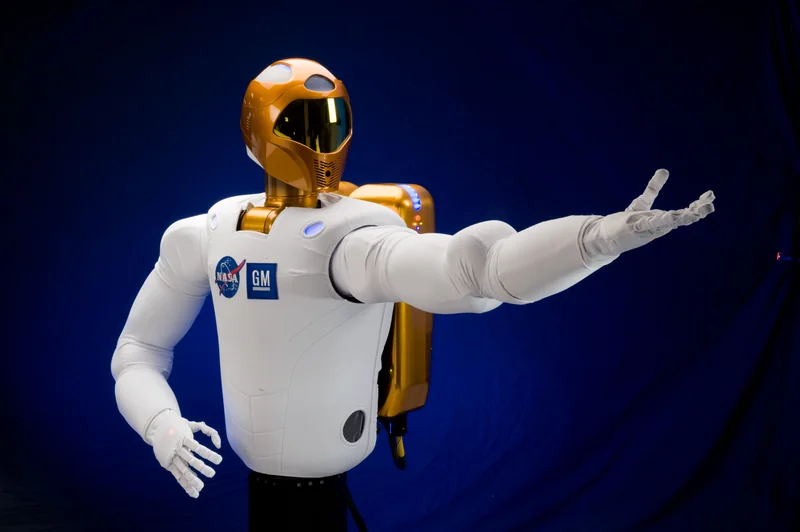
Humanoid
NASA and General Motors research robot, shown with an extended arm.
Photo: NASA / Robert Markowitz.

Drone
A quadcopter with a LiDAR payload, photographed on the ground.
Photo: Jonte.
Photographs resized and converted for web display, without cropping. The two photographs by Jonte remain available under CC BY-SA 4.0; the NASA photograph is public domain. Hardware selection and operating conditions would be assessed for each engagement.
Engagement options
Each offering has its own contract. Select the scope, access model and support arrangements that fit your needs.
Pricing structure
Before an engagement
Independent offerings
AXENTYR Robotics can be considered on its own. A combination is optional and starts with your needs.
Turn authorised sources into a clear view of the situation, its relationships, conflicting evidence and the options to examine.
Explore this offering 02Make assets, dependencies and coverage visible, then qualify alerts and coordinate the investigation of a cyber or operational incident.
Explore this offeringUseful questions
Manufacturing and purchase, rental or operated-service models remain undecided. The role described here is mission intelligence and integration. Hardware sourcing is assessed for each project according to suitability, availability and supplier terms; this is not an immediate supply promise.
Mission planning, sensor inputs, AI models, on-board or connected computing, operator review and links to client tools. Navigation, emergency controls and physical safety must remain independent of generative AI and respect the manufacturer’s operating limits.
Start with the task and environment, then consider a suitable quadruped, humanoid or drone. Assess sensors, model and computing needs, operator controls, manufacturer requirements and project-specific sourcing before defining acceptance and support.
Yes. Robotics has its own scope and contract, independently of Intelligence or Security. It can be designed around the client’s existing tools; the interfaces, hardware access, supervision, training and maintenance responsibilities must be agreed for the mission.
AXENTYR Robotics
Describe the task, site and platform you are considering. Scope the hardware assessment, mission intelligence, operator workflow and interfaces as one robotics project.
Scope a robotics project

